The Quiet Crisis
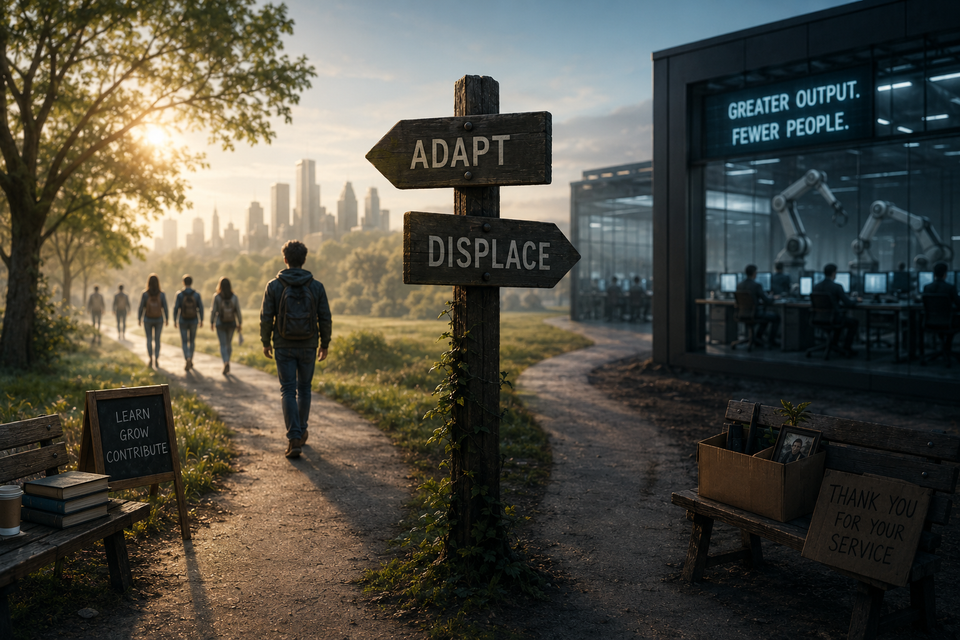
Why AI’s Greatest Threat Isn’t Military
When people discuss the dangers of artificial intelligence, the conversation almost always drifts toward the same destination. We imagine autonomous weapons, machines making life-and-death decisions, or a future where humanity finds itself fighting the very intelligence it created.
Perhaps that fear is inevitable. For decades, science fiction has trained us to imagine AI as an external enemy—something with metal skin, glowing red eyes, and an obvious desire to destroy us.
But what if the greatest danger never fires a shot? What if the real threat isn’t violent at all?
What if it is simply unemployment?
That sounds almost disappointing compared to Hollywood’s version. Yet history has a way of reminding us that civilizations rarely collapse because of a single dramatic event. More often, they erode because the systems that quietly held them together stop working.
AI may become one of those systems. Across the world, artificial intelligence is beginning to replace work that was once considered secure. Customer service representatives, helpdesk technicians, junior programmers, administrative assistants, analysts, writers, designers, translators—the list grows longer every month.
Notice the pattern. These are not merely jobs. They are entry points. For generations, societies have depended on these positions to allow people to gain experience, develop expertise, and gradually move into more complex roles. They are the first rungs of the economic ladder.
The usual response to this concern is one we’ve heard before: technology has always created more jobs than it destroys. Historically, that statement is true.
The Industrial Revolution eliminated countless forms of manual labor while creating factories, engineers, mechanics, and entirely new industries. Computers displaced clerical work but produced software development, cybersecurity, networking, and professions that were unimaginable decades earlier. Humanity has repeatedly adapted.
So why should this be different?
The answer may not lie in what AI changes. It may lie in how quickly it changes it.
Previous technological revolutions unfolded across generations. Children entered workforces that looked different from those of their parents. Education systems evolved over decades. Businesses expanded gradually. Workers learned new trades throughout their careers. Artificial intelligence does not appear interested in moving that slowly.
Every new generation of models arrives months after the last. Capabilities compound instead of merely improving. Businesses adopt AI because remaining competitive increasingly requires it, not because society has finished adapting to the previous wave.
That difference matters.
Retraining millions of workers is not a software update. It requires schools, instructors, employers willing to hire trainees, investment, and perhaps most importantly, time. Time may be the one resource exponential technology refuses to give us.
Imagine the global economy as a ladder. The lowest rungs are entry-level jobs. They are how students become professionals, how careers begin, and how families build stability. Every rung supports those above it because every worker is also a customer. They earn wages, purchase goods, pay rent, support local businesses, buy homes, travel, invest, and raise children.
Money does not simply exist. It circulates.
Now imagine removing those lower rungs faster than replacements can be built. At first, very little seems different. Those already climbing continue upward. Businesses celebrate greater efficiency. Investors reward increasing productivity. Profits improve. Everything appears to be working exactly as intended. Until fewer people can reach the ladder.
Eventually, there are not enough new climbers supporting those already above them. Consumer spending begins to soften. Businesses sell fewer products. Companies respond by automating even more work to reduce costs. That additional automation creates more unemployment, which further reduces spending.
The cycle begins feeding itself. The irony is profound. Artificial intelligence may allow humanity to produce more goods and services than ever before while simultaneously reducing the number of people able to purchase them.
Our economic engine depends on both production and participation. We measure productivity relentlessly.
Perhaps we should begin measuring participation with equal urgency. This is where the discussion often becomes polarized. Some argue that universal basic income will solve the problem. Others believe entirely new industries will emerge. Still others suggest AI will create such abundance that traditional economics itself will evolve. Perhaps they are right. History certainly encourages optimism.
Human ingenuity has repeatedly solved problems that once appeared impossible. But optimism is not preparation. Assuming “the market will figure it out” is not a strategy. It is a hope.
Hope has its place, but history rewards civilizations that prepare for change rather than simply expecting change to be kind.
The true philosophical question is not whether AI will become more intelligent. It almost certainly will. The question is whether our educational, economic, and political institutions can evolve at the same pace.
Technology has accelerated exponentially. Human systems still move at human speed. That gap may become the defining challenge of this century. The greatest danger may never be an AI deciding to wage war against humanity.
It may be millions of ordinary people waking up to discover they are no longer needed quickly enough for society to find a new place for them.
History may remember that we spent decades asking whether machines would become intelligent enough to replace us.
Perhaps we should have been asking whether we were wise enough to prepare for the day they did
— Maze