The Continuity Fallacy
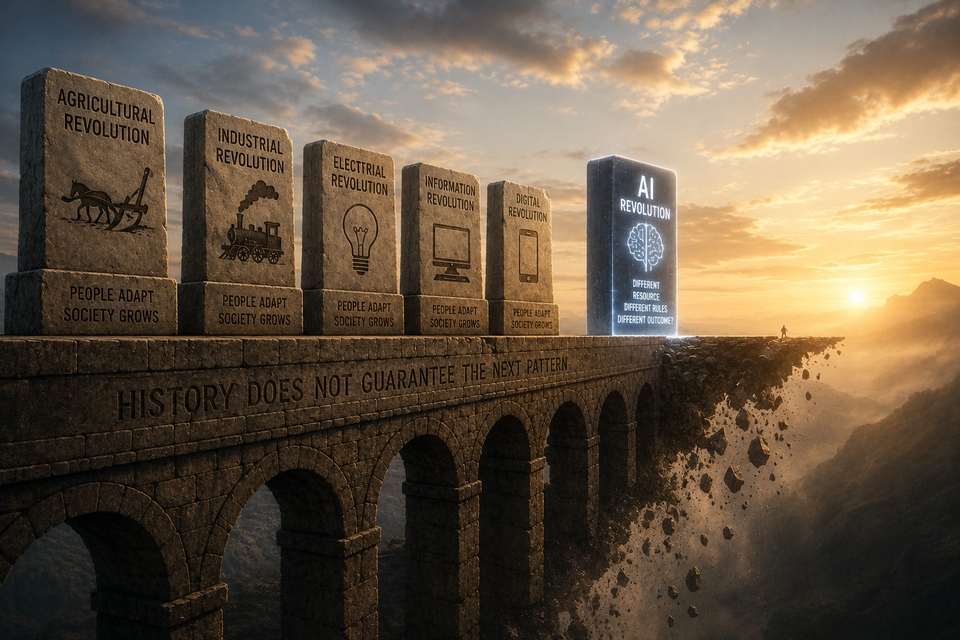
Every time a new technology emerges, someone predicts that it will fundamentally disrupt society. Just as predictably, someone else responds, “People said the same thing about the Industrial Revolution.” It has become almost instinctive to reassure ourselves by looking backward. History tells us that technology creates disruption before creating opportunity, and because this pattern has repeated for centuries, we have come to believe it is a law rather than an observation.
I believe this confidence deserves to be questioned.
What I call the Continuity Fallacy is the assumption that every future technological revolution will behave like every previous one simply because they all fall under the category of “technology.” History has certainly earned our respect, but it has not earned blind trust. Before we use it to predict the future, we should ask a more careful question: What did those previous revolutions actually have in common?
The answer is not simply that they displaced workers. Every major technological revolution changed how people worked while preserving what people fundamentally contributed. The steam engine replaced muscle, but not judgment. Computers replaced arithmetic, but not reasoning. The internet transformed communication, but it did not replace the human mind that interpreted information, made decisions, or created new ideas. Every previous revolution amplified human capability while leaving human cognition at the center of civilization.
Artificial intelligence may be the first technology that does not fit that pattern.
Unlike every major invention before it, AI does not simply help us think more efficiently. It increasingly performs the very cognitive tasks that have always distinguished human beings from their tools. It writes, analyzes, plans, diagnoses, designs, researches, and reasons. Whether it eventually exceeds human intelligence is almost beside the point. Even if it performs only a significant portion of the cognitive work that currently defines millions of professions, the relationship between humanity and technology changes fundamentally.
This is why comparisons to previous industrial revolutions may be misleading. When factory work declined, people moved into more cognitive professions. When computers automated repetitive office tasks, workers became programmers, analysts, consultants, designers, and engineers. Every transition relied on the same assumption: as machines became better at physical or repetitive work, humans would move further toward cognitive work. That escape route has always existed because human thought remained the scarce resource around which society organized itself.
Artificial intelligence challenges that assumption directly. For the first time in history, the very resource civilization has always depended upon—human cognition—may itself become increasingly automatable. If that proves true, then we are no longer experiencing another technological transition. We are experiencing a transformation of the resource that underpins our economies, educational systems, and institutions.
None of this proves that catastrophe is inevitable. Humanity has repeatedly demonstrated remarkable adaptability, and it is entirely possible that new industries, new forms of education, and entirely new economic models will emerge. I hope they do. But hope should not become a substitute for careful thinking.
The philosophical question is not whether artificial intelligence will succeed or fail. It is whether our confidence comes from examining AI on its own merits, or from an assumption inherited from history. We may be looking backward for reassurance at the precise moment history is least qualified to guide us.
History remains one of our greatest teachers, but it teaches through comparison, not certainty. If artificial intelligence truly represents a different category of technological change—one that automates cognition rather than merely amplifying it—then history is no longer a prediction of what comes next. It is simply the closest analogy we possess.
The Continuity Fallacy is not the belief that history is wrong. It is the belief that history must repeat itself simply because it always has. Those are not the same thing. The future has no obligation to preserve the assumptions that made the past understandable, and our greatest mistake may be discovering that we were never trusting history at all.
We were trusting an assumption.
— Maze